Outsourcing web development to India has a reputation problem. For every company that built its product with an Indian team and never looked back, there’s a founder with a story about a missed deadline and an unusable codebase.
Both stories are true. The difference is almost never the country — it’s how the partner was chosen and how the project was run.
This guide is written from the other side of the table. We’re a web and app studio in India working with clients abroad, and these are the things that make outsourcing work — or fail.
Why Companies Outsource to India
- Cost. Senior-quality work at a fraction of US, UK or Australian rates.
- Talent. India has one of the largest pools of software developers in the world, with deep experience in JavaScript, React, Node.js, Java and Shopify.
- English. Most developers and project managers work comfortably in English.
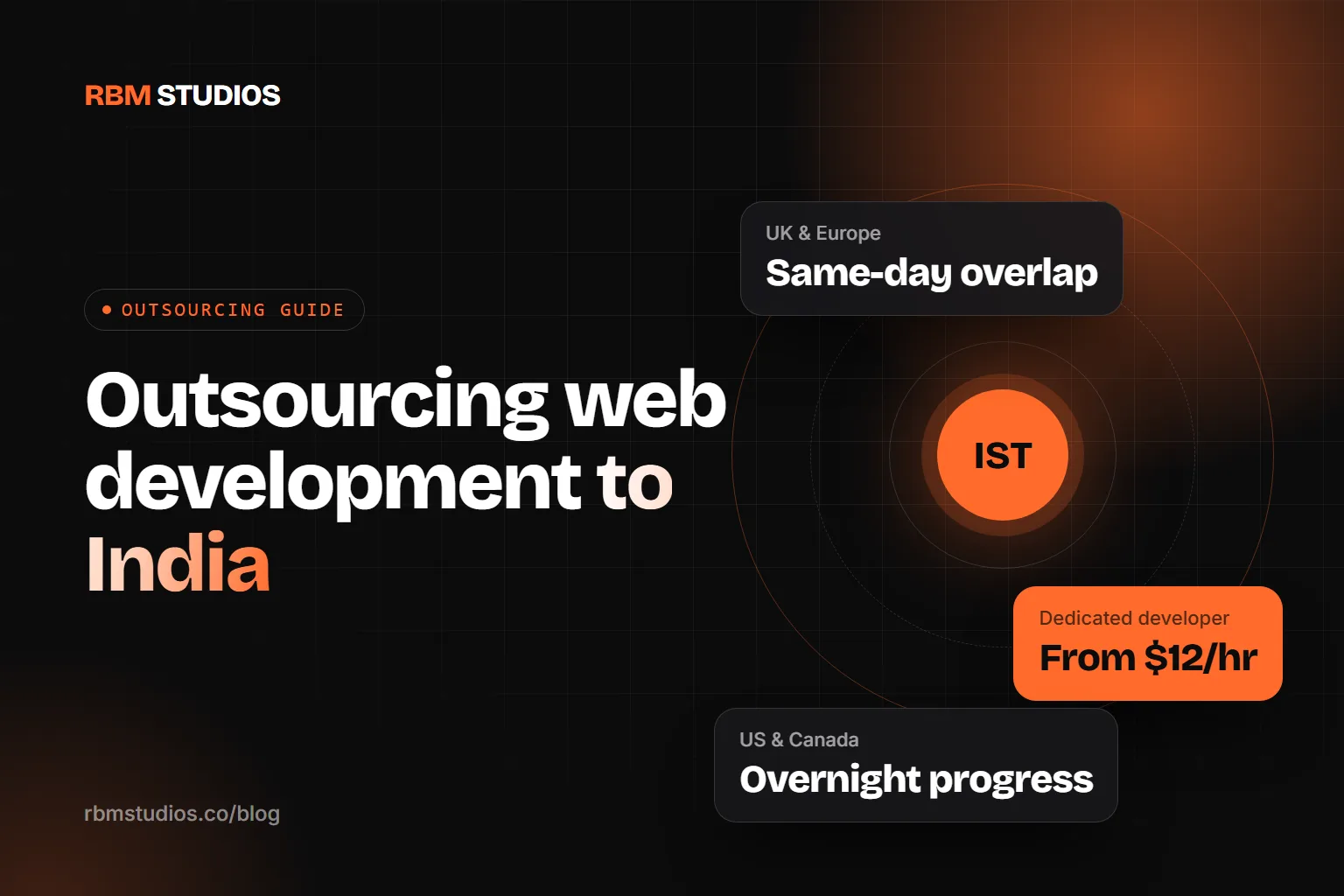
- Time zones. India Standard Time (UTC+5:30) overlaps with the full UK and European working day, the Middle East and Australia, and gives US teams overnight progress plus a morning or evening overlap.
What It Really Costs
Rates vary widely by experience, company size and city. As a rough guide in 2026:
| Who you hire | Typical hourly rate (USD) | Best for |
|---|---|---|
| Freelancer | $10 – $30 | Small, well-defined tasks |
| Small studio | $12 – $35 | Websites, stores, MVPs, ongoing work |
| Mid-size or large agency | $25 – $60+ | Large, multi-team programmes |
For context, our own dedicated developers start at $12 an hour, or $1,399 a month full-time. Fixed-price websites start at $279, and you can see every price on our pricing page.
The cheapest rate rarely means the cheapest project. A developer at $25 an hour who gets it right first time costs less than one at $10 who needs three attempts.
Four Ways to Work Together
1. Fixed-price project
You agree the scope, price and timeline up front. Ideal for websites, online stores and well-defined MVPs.
2. Hourly (time and materials)
You pay for the hours worked. Flexible, and good for maintenance, fixes and work where the scope is still moving.
3. Dedicated developer
A developer works for you full-time or part-time on a monthly fee, inside your tools and processes. It’s the closest thing to an in-house hire, without recruitment or employment overheads. See how it works on our hire developers page.
4. White-label partner
For agencies: the outsourcing partner builds under your brand and never talks to your client directly. More on this in our white-label development page.
How to Choose the Right Partner
Look at live work, not screenshots. Ask for links to sites and apps that are online today. Open them on your phone. Are they fast? Do they work?
Talk to the person who will do the work. Not just the salesperson. A 20-minute call tells you a lot about communication and understanding.
Start with a small paid trial. A one-week trial or a small first milestone is the best predictor of the next six months.
Check reviews. Platforms like Clutch and GoodFirms verify client reviews. Ask for one or two references you can actually speak to.
Ask about process. How often will you see progress? Where will the code live? Who tests it? What happens if a developer leaves?
The Mistakes That Sink Outsourced Projects
- Choosing the lowest bid. If one quote is half of everyone else’s, something has been left out.
- A vague brief. “Build something like Airbnb” is not a scope. Write down users, features and what “done” means.
- No access to the code. If the code doesn’t live in a repository you own, you don’t really own your product.
- Paying everything upfront. Tie payments to milestones you can see and test.
- No regular demos. Weekly or fortnightly demos catch misunderstandings while they’re still cheap to fix.
- Ignoring the handover. Ask for documentation, credentials and a walkthrough before the final payment.
How to Make It Work
- Share a one-page brief — goals, users, must-have features, examples you like and your budget range.
- Agree milestones with a demo and acceptance criteria for each.
- Use shared tools — Slack or WhatsApp for chat, Jira or Trello for tasks, GitHub for code.
- Book a recurring call inside the overlap hours, even if it’s only 15 minutes.
- Keep ownership simple — domains, hosting, app store accounts and repositories in your company’s name from day one.
Contracts and Payments
Before work begins, you should have:
- A contract with scope, timeline, payment milestones and a change-request process
- An NDA, if your idea or data is sensitive
- An IP assignment clause confirming that everything built belongs to you
International projects with Indian studios are usually invoiced in USD and paid by international bank transfer or services such as Wise or PayPal — confirm the options with your partner.
The Bottom Line
Outsourcing to India works brilliantly when you choose for quality and communication — not just price — and run the project with clear scope, regular demos and code you own.
If you’re weighing it up, tell us what you’re building. We’ll give you an honest view of scope, timeline and cost — even if the answer is that you don’t need us yet.